Trading basicsComparison
Cross vs Isolated Margin: What's the Difference?
Answer
Cross margin uses the available balance of one margin asset (often a settlement coin in the futures account) to support several positions in that mode: one position's floating loss can be buffered by the shared pool, but in extremes the same pool can be dragged into liquidation together. Isolated margin assigns a relatively separate margin to one position: in the worst case that position's loss is usually bounded mainly by that assigned margin, and it does not automatically pull funds you left for other positions. If you still cannot say "which money can be wiped," prefer Isolated until the single-trade risk is clear. If you knowingly want shared margin for hedges or capital efficiency, then consider Cross — either way, first learn how much one trade can lose. Liquidation price, maintenance margin, and whether you can switch with open positions follow your platform's product rules.
Contents
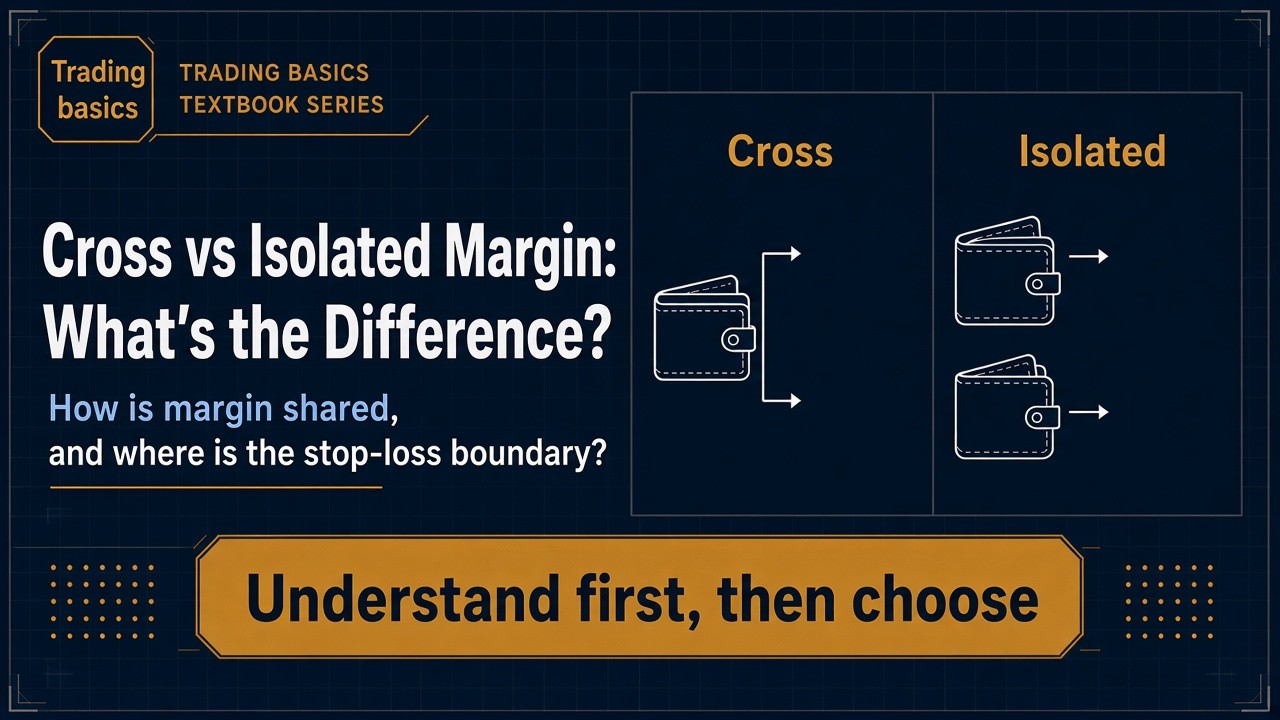
Cross vs Isolated
Cannot yet name the max loss on one trade, or want risk boxed to "this position" → start with Isolated. Already understand shared-margin chain effects and need multi-position support or hedge efficiency → then Cross. Neither mode "makes money safer" — they change how money is shared and how far a blow-up reaches.
| Dimension | Cross | Isolated |
|---|---|---|
| How margin is used | Cross positions under the same margin asset usually share one pool | Each Isolated position takes and accounts for its own margin |
| Loss and liquidation boundary (common wording) | Adverse moves may draw more of the pool; in extremes same-pool funds and Cross positions are more tightly coupled | Loss on that position usually falls mainly on its assigned margin; other positions' margin is not auto-consumed |
| Capital efficiency | Idle balance can support several positions; sometimes cushions one position's drawdown better | Once assigned, margin cannot casually rescue another position; a single position can hit liquidation sooner on its own |
| Effects between positions | One loss can be buffered by other funds/P&L in the pool — or drag the whole pool | More isolated: one liquidation does not equal wiping every Isolated book (you can still lose that position's margin) |
| Who it tends to fit | Traders who understand shared risk and need hedges or higher utilization | Beginners, single-idea trials, or anyone who must state "this trade's max loss" clearly |
| Switching with open positions | Most platforms: you cannot freely switch Cross/Isolated while a position is open | Same — pick the mode before you open; official docs win |
Key facts
- Scope of this page
- Margin mode (Cross / Isolated), not UI "split position" displays — those usually do not change how liquidation is calculated
- Key metrics (common)
- Maintenance margin ratio / margin ratio: closer to the platform threshold means higher risk; formulas and mark price follow the product page
- Link to spot vs futures
- Cross and Isolated are options on margined futures/leverage paths; spot vs futures first: Spot vs Futures Trading: What's the Difference?
- Ask before you act
- Which money am I willing to lose on this trade? Can one loss drag other positions in the same account? Can I change mode with open size? Are stop and size already calculated?
What this page does not cover
- No recommended leverage, symbols, or claims that Cross "makes more money."
- Account structures (unified accounts, multi-asset collateral) differ; this page only covers shared vs isolated logic.
- Isolated is not risk-free: you can still lose that position's margin, and slippage, fees, or funding can miss expectations.
- Brand order steps live in exchange guides, e.g. How to Place a Binance Futures Order.
FAQ
Should a beginner pick Cross or Isolated?
Most beginners should start with Isolated: pin "max loss on this trade" to visible margin. Switch to Cross only when you can explain shared and chain risk in your own words.
Is Cross harder to liquidate?
Sometimes the shared pool cushions one position longer — and a large loss can drag more balance with it. Not "safer"; a different risk shape.
If Isolated liquidates, is the whole account gone?
Under common rules, Isolated liquidation loss falls mainly on that position's margin; other positions and unassigned balance are usually more separate. Still follow your platform's disclosure and keep emergency funds.
Can I switch modes after opening?
Many platforms forbid a direct Cross ↔ Isolated switch with open positions. Habit: flatten or change mode with no position, then open again.
Is Isolated the same as "split positions" in the UI?
Usually not. Isolated is how margin and risk are ring-fenced; split/display tools are often UI only, while liquidation may still use combined rules. Use the platform's glossary.
After picking a mode, do I still need position sizing?
Yes. Mode decides how money is shared; size and stop decide the risk amount. See How to calculate position size and the Position Size Calculator.