Trading basicsComparison
Spot vs Futures Trading: What's the Difference?
Answer
Spot usually means buying or selling the asset (or a deliverable position) at the current price; profit and loss come mainly from the gap between buy and sell. Futures/derivatives (including many perpetuals and CFD-style products) more often use margin to take price exposure, long or short — but losses can be leveraged, and low margin can force liquidation. If you only want to "buy and hold without leverage," you are closer to spot. If you explicitly need two-way trading or leverage, you enter futures — and you must already know how much one trade can lose. Both can wipe principal; futures usually get there faster.
Contents
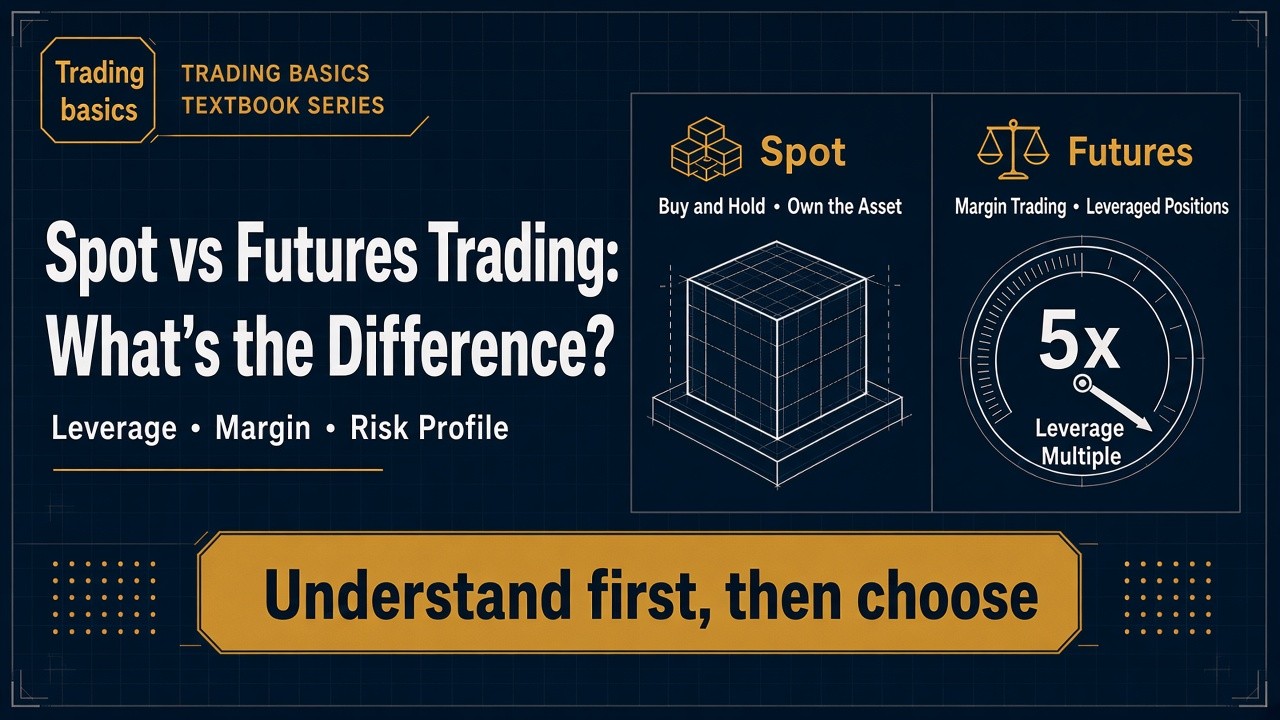
Spot vs Futures / derivatives
No leverage planned, mainly buy low / sell high (or sell what you already hold) → start with spot. Need shorting or deliberate leverage and you can already write a stop and a size → then consider futures. "I want to get rich faster" is usually the wrong reason to pick futures.
| Dimension | Spot | Futures / derivatives |
|---|---|---|
| What you trade | Often the asset itself or a deliverable position (product terms decide) | Often price exposure; not the same as long-term ownership of the underlying |
| Direction | Mostly buy then sell; easy shorting depends on the market and product | Long and short are both common; contract specs win |
| Leverage and margin | Usually full cash or product rules; leverage is not the default | Margin is common; notional can exceed the balance; P&L scales both ways |
| How losses look | Floating loss when price moves against you; usually no "margin ratio" auto-liquidation (you can still lose most of the stake) | Besides price loss, margin calls or forced liquidation (blow-up path) can trigger |
| Holding costs (typical) | Trading fees, spread; custody/withdrawal fees vary by platform | Beyond spread/commission, funding or overnight fees may apply — longer holds hurt more |
| Who it tends to fit | People learning buys, sells, and custody who do not want leverage yet | People who understand liquidation and the size formula, and accept more operational complexity |
Key facts
- "Futures" on this page
- A broad label for margined, two-way derivative paths (including common perpetual / CFD-style stories). Use your platform's product page for the real name — marketing words are not enough.
- Down a little right after entry?
- There is often a spread between bid and ask; a market order pays it in the fill. See What Is the Spread?.
- Ask yourself before you act
- Do I need to short? Can I accept liquidation? What % of the account may one trade lose? Can I already size a position?
What this page does not cover
- No tips on symbols, leverage multiples, or "sure win" uses.
- Available products and investor suitability differ by country — local law and platform disclosures win.
- Spot is not risk-free; futures are not "more advanced" by default.
- Brand sign-up and order steps live in the exchange series, e.g. How to Place a Binance Futures Order.
FAQ
In crypto, is "futures" the same as traditional futures?
Names are mixed. Some products are close to traditional futures; others are perpetual swaps or CFD-style. Read settlement, funding, and liquidation rules on the product page — not only the button label.
Can spot losses exceed what I put in?
In a common unlevered spot buy, loss is usually capped at what you spent (you can still lose almost all of it). Financing, leverage, or shorting changes the rules.
Do futures always need high leverage?
No. Many platforms allow low leverage — "can choose low" is not "will choose low." Size and stop matter more than the leverage number.
I want to practice first — which one?
Most people should learn spot buys/sells and account safety with small money, then learn futures liquidation on a demo or tiny size. Learning order: Can a Complete Beginner Learn to Trade?.